
Neuroevolution Maze Solver
Advertisement
Settings
10
Simulation Statistics
Jenerasyon:
0
En İyi Skor:
0
Canlı Ajan:
0
Neuroevolution Maze Solver
This simulation develops agents that learn to solve mazes using artificial neural networks and genetic algorithms.
Mathematical Model and Technical Details
Artificial Neural Network Architecture
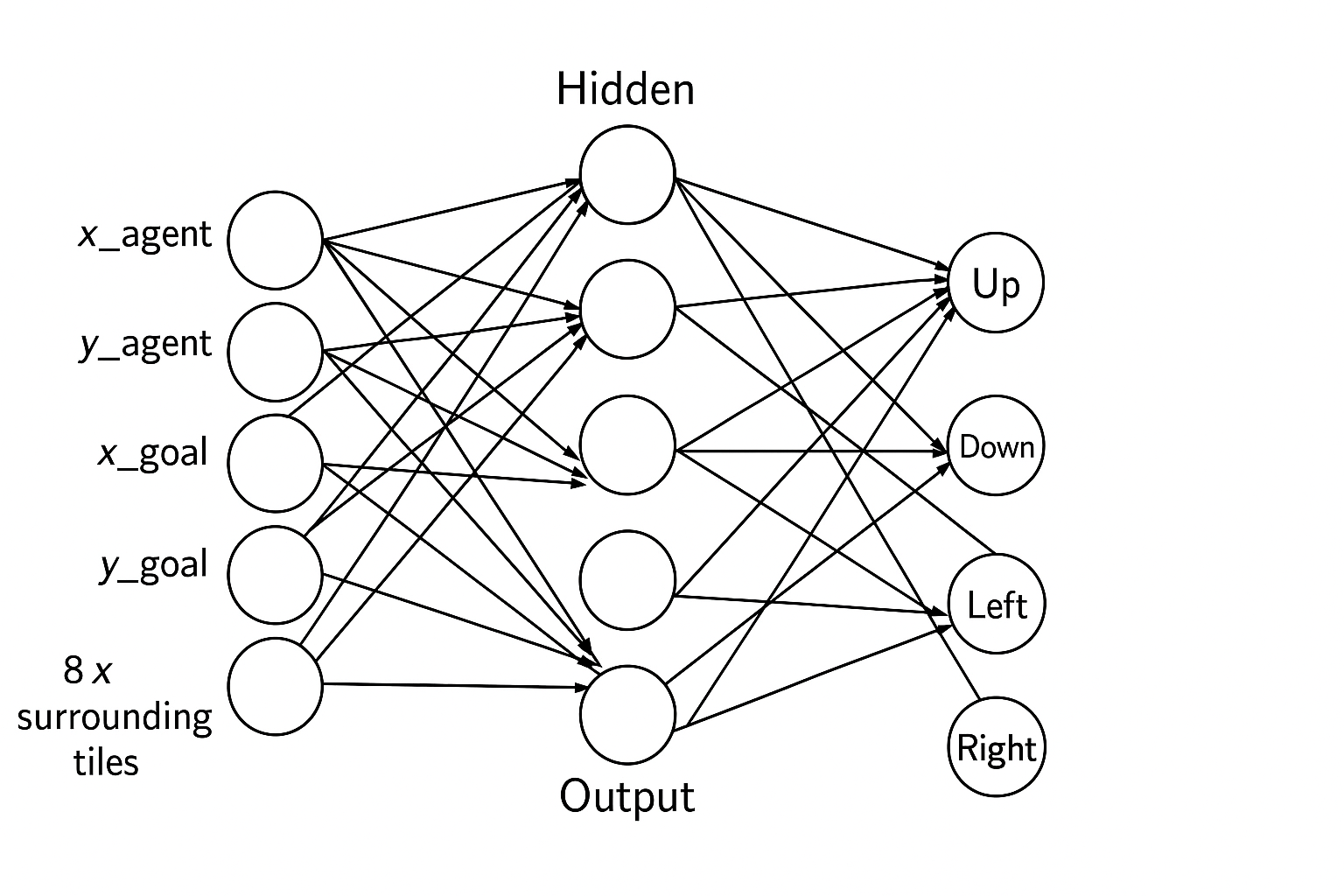
- Input Layer: 8 neurons - Detects wall presence in 8 directions around the agent (north, northeast, east, southeast, south, southwest, west, northwest)
- Hidden Layer: 4-8 neurons - For processing and pattern recognition
- Output Layer: 4 neurons - Represents the agent's movement directions (up, down, left, right)
Mathematical Operations
Each neuron applies weighted sum and activation function:
Z = W·X + B
A = σ(Z)
Where W is the weight matrix, X is the input vector, B is the bias term, and σ is the activation function (typically ReLU or sigmoid).
Genetic Algorithm Process
- Initial Population: Start with neural networks having random weights
- Evaluation: Each agent is tested in the maze, fitness score is calculated:
- Fitness = Proximity to target - Collision count × penalty
- Selection: Agents with highest fitness scores are selected based on elitism rate
- Crossover: Neural network weights of selected agents are mixed to create new generation
- Mutation: Random changes are applied to weights in the new generation
Optimization Parameters
- Elitism Rate: Percentage of best agents directly transferred to next generation
- Mutation Rate: How frequently new weights are altered
- Mutation Range: Magnitude of weight changes
- Random Behavior: Probability of random movement for exploration-exploitation balance
Application Areas
- Autonomous navigation systems
- Robotic path planning
- Game AI development
- Solving optimization problems
- Decision-making mechanisms in real-world scenarios
Advertisement
Contact